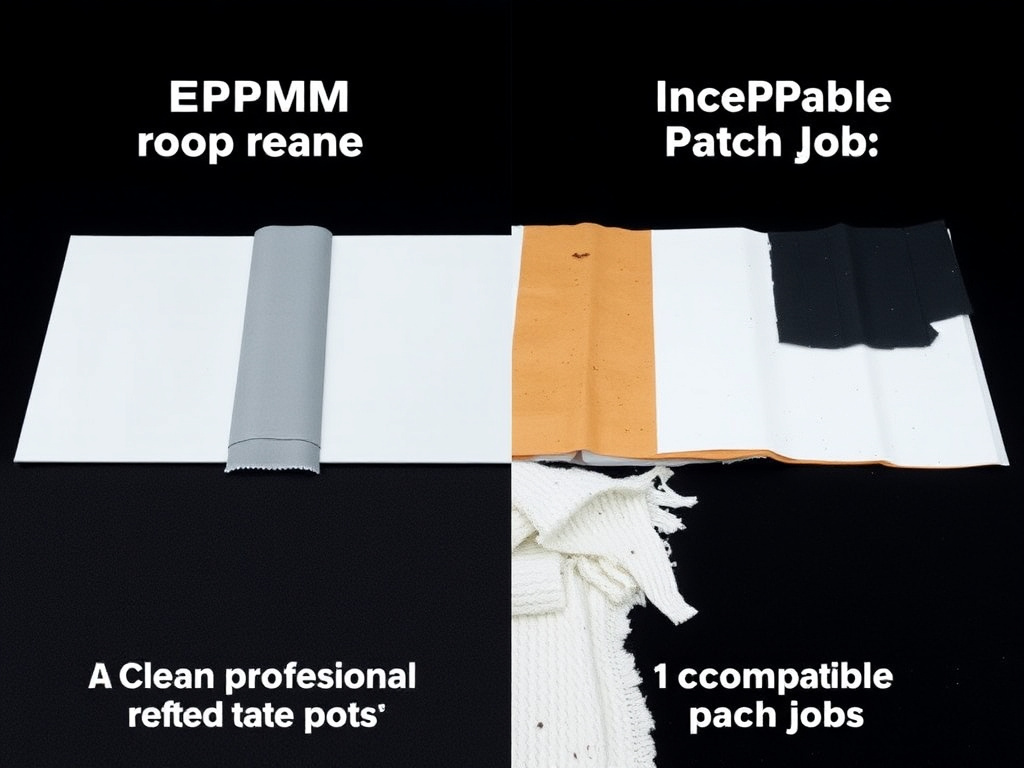
The comparison guide
Warranty-Compliant Repair vs. DIY & Uncertified Repair
A patch is a patch until a manufacturer's warranty department looks at it. Here's what actually separates a repair that protects your existing EPDM warranty from one that quietly ends it — and what to do if the uncertified repair already happened.
The setup
A small leak, a fast patch, and a warranty problem nobody notices yet
It usually starts small. A pinhole leak over a storage room, a lifting seam nobody budgeted for, a penetration that starts weeping after a hard rain. Someone on site — a maintenance tech, a handyman, a general contractor already on the property for something else — patches it. The leak stops. Everyone moves on.
What doesn't show up that day is the warranty question. If that roof carries an active manufacturer warranty, the patch material, the adhesive chemistry, and who performed the work all matter to that warranty's terms — regardless of whether the fix actually worked. A repair can stop water and still create an unapproved modification at the same time.
The problem almost never surfaces on patch day. It surfaces months or years later, when a much bigger failure prompts a closer look at the roof's repair history — and a warranty department finds a repair that doesn't match the program the roof was installed under. By then, the original small leak is the least of the building owner's problems.
None of this means every repair needs to be a major production. It means the person deciding how to fix a leak needs to know, before the first patch goes down, whether that roof carries a warranty that constrains the choice — and if it does, what materials and installer standing that warranty actually requires.
This page exists to close that gap: what separates a warranty-compliant repair from a DIY or uncertified one, how that difference actually gets evaluated, and what your options are if an uncertified repair has already happened on your roof.
Side-by-side
Warranty-compliant repair vs. DIY & uncertified repair
The two columns below aren't about workmanship quality in the abstract — an uncertified repair can look perfectly clean and still create a warranty problem. The difference is in what was used, who did it, and whether it can be traced. See our warranty-compliant patch materials for how material sourcing works in practice.
Warranty-Compliant Repair
| Material Sourcing | Membrane, tape, and patch stock sourced to match the roof's original manufacturer and warranty program — not a generic universal product. |
|---|---|
| Adhesive & Primer Compatibility | Adhesives and primers matched to the manufacturer's specified chemistry for that membrane, so the bond is recognized as part of the approved system. |
| Installer Certification | Performed by, or under, an installer with the training and standing the manufacturer's program requires for repair work. |
| Documentation Produced | Material lot numbers, installer records, and a dated repair report suitable for the building's permanent warranty file. |
| Effect on Existing Manufacturer Warranty | Repair is performed inside the terms the manufacturer already agreed to — existing warranty status is preserved. |
| Effect on Future Repair Eligibility | Roof remains eligible for manufacturer-recognized repair and inspection programs going forward. |
DIY / Uncertified Repair
| Material Sourcing | Whatever patch kit, tape, or sealant is on hand or easiest to source — rarely matched to a specific manufacturer program. |
|---|---|
| Adhesive & Primer Compatibility | Adhesive or primer chemistry may not be compatible with the existing membrane, even if the patch material itself is technically EPDM. |
| Installer Certification | Performed by a handyman, in-house maintenance staff, or a roofer with no standing in the original manufacturer's program. |
| Documentation Produced | Little to none — often no lot numbers, no dated report, nothing to add to a warranty file even if the fix holds. |
| Effect on Existing Manufacturer Warranty | May be treated as an unapproved modification, which can affect warranty status for the repaired section or, in some programs, the whole roof. |
| Effect on Future Repair Eligibility | Section (or roof) may need to be reassessed, and in some cases re-certified, before it can re-enter a manufacturer repair or inspection program. |
Notice that "documentation" and "installer certification" are their own rows, separate from the material itself. A roof can end up with the right membrane and the wrong paper trail, or the right installer and the wrong adhesive — either gap can matter to a warranty department, which is why compliance is a full-column question, not a single checkbox.
How this actually gets evaluated
How manufacturers evaluate a warranty question after an unapproved repair
Every manufacturer program has its own specific terms, and we won't pretend to know the exact evaluation process any one program follows — that's between the building owner, the warranty holder, and the manufacturer. But there's a general pattern that holds across most EPDM warranty programs when a repair question comes up.
First, what material was actually used. A manufacturer or its representative will typically want to know whether the patch, tape, adhesive, or coating applied is recognized as compatible with the original installed system — or whether it's an unrelated product that happened to be available.
Second, who performed the work. Many warranty programs, particularly NDL and other system-level warranties, specify that repairs be performed by a certified or authorized installer. Work done outside that requirement can be treated differently than the same physical repair performed through a manufacturer-certified repair program.
Third, whether it was documented. A repair with a dated report, material lot numbers, and a clear record of who did the work is something a manufacturer can evaluate on its merits. A repair with no paper trail leaves the manufacturer working from whatever they can observe on the roof itself — which tends to work against the building owner, not for them.
None of that is a guarantee any particular warranty claim will be resolved a certain way — every program's terms differ, and this is meant as a general pattern, not a promise about how a specific manufacturer will rule. What it does mean is that the same three questions keep coming up, and a building owner who can answer all three clearly is in a materially better position than one who can't.
Illustrative patterns, not case studies
What this looks like in practice
These are generalized, illustrative examples of common patterns we see across the industry — not records of specific real projects.
The hardware-store patch kit
A generic EPDM repair kit, sold for small residential or DIY jobs, gets used on a certified commercial roof under an active manufacturer program. The patch may hold fine — but the adhesive chemistry and membrane stock were never evaluated against that specific program's requirements.
The generic sealant at a penetration
A weeping pipe boot or curb flashing gets a bead of general-purpose roofing sealant instead of the manufacturer-specified detail repair. It's a common, well-intentioned fix — and a common way an otherwise-compliant roof picks up an unapproved detail repair.
The maintenance crew helping out
An in-house facilities team, trying to save time and money, tapes over a lifting seam with whatever tape is in the truck. The intent is entirely reasonable. The result is still an uncertified repair on a roof that may require certified work for warranty purposes.
The common thread across all three patterns isn't incompetence — it's that nobody paused to ask what the roof's specific manufacturer program actually required before the material went down. That's usually the only difference between a repair that quietly holds its warranty status and one that quietly doesn't.
If it's already happened
What to do if a DIY or uncertified repair has already happened
Finding out an uncertified repair already happened isn't a dead end — it's a starting point. The path back toward compliance, where one exists, generally begins with an honest assessment rather than a guess. It also isn't a reason to wait — the sooner an uncertified repair is identified, the more options are usually still on the table.
We start by identifying the roof's original manufacturer and warranty terms, then locating and evaluating whatever repair work has already been done — what material was used, where, and how it was applied. That tells us whether the affected area can be brought back into compliance, whether it needs to be reworked entirely, or whether it's simply something to document going forward.
From there, the remediation path is specific to what we find. Sometimes it's as straightforward as removing an incompatible patch and replacing it with a compliant one. Other times it means building the documentation that should have existed from the start, so at least the roof's ongoing record is accurate and defensible — see our warranty documentation programs for what that looks like on an ongoing basis.
A typical assessment covers:
- ✓Confirming the roof's original manufacturer and warranty tier
- ✓Locating and evaluating any prior uncertified repair work
- ✓Testing material and adhesive compatibility at the repair site
- ✓Determining whether the section can be brought back into compliance
- ✓Building documentation for what's found, going forward
Common questions
Warranty-compliant vs. DIY repair — FAQ
Does patching my own EPDM roof always void the manufacturer warranty?
+
Not automatically, but it's a real risk. Most manufacturer warranties are conditional — they require specific materials, adhesives, and often a certified installer for any repair work. A DIY patch that doesn't meet those conditions can be treated as an unapproved modification, even if it successfully stops the leak and looks fine from the ground.
How would a manufacturer even find out an uncertified repair was done?
+
Warranty questions typically surface later — during a routine inspection, a subsequent repair call, or when a much bigger issue prompts a closer look at the roof. At that point, a manufacturer or its representative generally looks at what material was used, who performed the work, and whether it was documented, which is when an earlier uncertified patch tends to come to light.
Is a small DIY patch really treated the same as hiring an uncertified roofing crew?
+
The scale of the work differs, but the underlying warranty question is the same: was the correct material used, by someone with standing in the manufacturer's program, and was it documented? A single small patch and a full uncertified crew visit can both raise that same question — size alone doesn't determine warranty impact.
Can a warranty-compliant repair be performed after an uncertified one already happened?
+
Often, yes. The starting point is an assessment of what was used and where, followed by a plan to bring the affected area back into compliance where that's possible. It won't always fully undo the original impact on warranty status, but it's almost always better than leaving an uncertified repair in place unaddressed and undocumented.
The short version of everything above: the material matters, who does the work matters, and whether it's written down matters. Get those three right and a repair protects the warranty you already have. Get any one of them wrong, and the fastest fix on the roof can become the slowest problem in the building's file.
Not sure if a past repair put your warranty at risk?
Tell us about your roof, its manufacturer, and any repair work already done. We'll assess where things stand and lay out a plan to get — or keep — your warranty compliant.