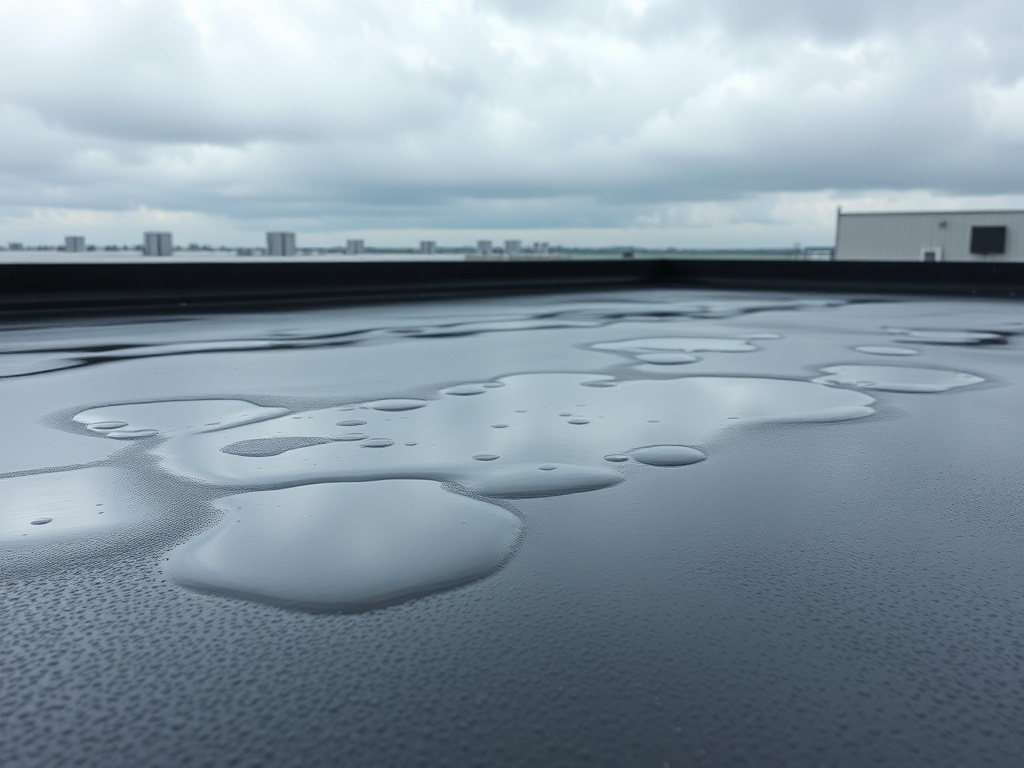
Correction, not just correction
Ponding Water & Drainage Correction
Standing water can put an existing warranty at risk on its own — but a drainage 'fix' performed the wrong way can create a brand-new warranty exclusion. We correct ponding and drainage problems to the specification that keeps both the original warranty and the correction itself in force.
How exclusions typically work
How ponding-water exclusions typically work in manufacturer warranty language
Most EPDM manufacturer warranty programs draw a distinction between water that drains within a defined window after rainfall and water that sits beyond it. Many warranties define a maximum ponding duration — commonly somewhere in the 24- to 48-hour range after precipitation, though the exact figure varies by manufacturer and program tier — and exclude or limit warranty coverage for membrane damage that occurs from water standing longer than that window. The logic is straightforward from the manufacturer's side: EPDM is designed to shed water, not hold it indefinitely, and prolonged immersion accelerates seam stress, ballast movement, and UV-exposure patterns the original design didn't account for.
This is why "many warranties exclude coverage for prolonged ponding water" is one of the more consistent patterns across manufacturer programs, even though the exact duration threshold and the specific language used differ from one program to the next. It's also why ponding water gets treated differently from almost every other warranty question on a roof — it isn't about which material or installer was used. It's about a physical condition (standing water past a defined duration) that can limit warranty coverage regardless of how well the original repair or installation was performed.
For a building owner or property manager, the practical implication is that identifying ponding early — and documenting how long it actually sits after a rain event — matters more than it seems. A roof with a few isolated low spots that drain within the warranty's defined window is a very different situation, warranty-wise, than the same low spots on a roof where water has been observed sitting for days. The first is a maintenance item. The second is a potential coverage question the next time a warranty claim is filed for unrelated membrane damage nearby.
We start every ponding assessment by documenting where water is actually collecting, how deep it sits, and — where we can establish it from site visits or maintenance logs — how long it typically takes to drain. That record is what determines whether the right next step is a targeted drainage correction or simply closer monitoring.
It's also worth noting what ponding-duration language does not usually mean. A defined duration threshold isn't typically a blanket exclusion on every square foot of the roof the moment water sits past it — most programs apply it specifically to damage attributable to the ponding itself, in the areas actually affected. That distinction matters when a warranty question comes up: the relevant fact isn't just "does this roof have ponding somewhere," it's exactly where, how deep, and for how long, which is why documentation at the individual low-spot level is worth more than a general statement that a roof "has some ponding."
The correction can be the problem
Why a drainage "fix" can itself void warranty if done wrong
This is the part of ponding correction most building owners never hear until after a problem shows up: the correction itself is a modification to a roof system that's already under a manufacturer warranty, and most manufacturer programs require that any structural or drainage modification — added insulation, new drains, tapered crickets — be performed with approved materials, by an approved installer, and often with prior notice or approval from the manufacturer. Skip that process, and a drainage correction meant to protect the warranty can become the exact unapproved modification that puts it at risk instead.
A few of the most common ways this happens in practice: tapered insulation installed with a fastening pattern that doesn't match the manufacturer's uplift requirements for that roof; a new drain sump cut and flashed without the manufacturer-specified drain detail; or a cricket built with a slope too shallow to actually move water off, adding new dead-level area rather than eliminating it.
None of these mistakes are visible from the ground, and most of them won't cause an immediate leak. They surface later — at the next manufacturer inspection, or when a warranty claim is filed for something unrelated and the inspector notices an undocumented drainage modification while on the roof for another reason. At that point, the correction that was supposed to protect the roof's warranty coverage becomes the reason a claim gets questioned.
This is why we treat every drainage correction as its own compliance project, not a side effect of a repair. Before recommending tapered insulation, a new drain, or a cricket, we confirm what the manufacturer's modification process requires for that specific roof and program — including whether prior notice or approval is needed before work starts.
There's a related trap worth flagging directly: a drainage correction is also a roof-loading and attachment change, not just a slope change. Adding insulation layers shifts the fastening pattern requirements for wind uplift, and a cricket built without accounting for the surrounding field membrane's existing attachment can leave a transition zone under-fastened. A correction that solves the ponding problem but creates an uplift or attachment gap hasn't actually fixed anything — it's traded one compliance issue for another.
Compliant correction methods
Compliant correction methods
The right correction method depends on how much of the roof is affected, how deep the low spots are, and what the existing insulation and drain layout already look like. In most cases it's one of the three approaches below, performed to the manufacturer's modification spec rather than a generic drainage fix. Isolated, shallow low spots away from drains are often correctable with tapered insulation alone. Larger areas, or low spots that sit far from the nearest drain, more often call for a combination of tapered insulation and either a repositioned drain or a new cricket to actually redirect water rather than just re-slope it in place.
Assess & document
Map every low spot, measure standing depth, and establish drain-time patterns against the applicable warranty's ponding-duration language before recommending any correction.
Confirm modification requirements
Identify whether the manufacturer program requires prior notice, submittal approval, or a specific installer certification before drainage work begins on that roof.
Tapered insulation
Re-slope isolated low spots with tapered insulation boards fastened to the manufacturer's approved pattern, restoring positive drainage without disturbing unaffected membrane areas.
Drain retrofits & crickets
Add or reposition drains, or build crickets at structural low points, using manufacturer-specified drain details and slope minimums so the new drainage path actually clears water.
Verify & document the fix
Confirm post-correction drainage performance after a rain event and produce the paperwork the warranty file needs to show the modification was approved and compliant.
None of these steps are optional shortcuts to skip when a low spot looks minor. Even a small, isolated correction still needs the same modification-requirements check and the same post-correction verification as a larger project — the manufacturer's approval process generally doesn't scale down for a smaller repair, and an undocumented "quick" tapered-insulation patch carries the same compliance exposure as an undocumented large one.
Documentation
Documenting a drainage correction for the warranty file
A drainage correction that isn't documented is, from a warranty administrator's perspective, indistinguishable from one that was never approved. Every correction we perform is recorded with the same level of detail a manufacturer's own field team would expect to see: pre-correction ponding measurements and photos, the specific materials and fastening pattern used, any manufacturer notice or approval obtained before work started, and post-correction drainage verification after the next rain event.
That record gets added directly to the roof's warranty file — the same file we help build or rebuild through our warranty documentation programs. For a building that already has gaps in its paperwork, a drainage correction is often a good opportunity to close some of those gaps at the same time, rather than adding one more undocumented modification to an already incomplete file.
The specific records worth keeping are straightforward, even if they're easy to skip under time pressure: dated photos of the low spot before work starts, the product data sheet or lot number for any tapered insulation or drain hardware used, written confirmation of any manufacturer notice or approval obtained, and a dated photo set of the same area after the next meaningful rain event showing the water actually clearing. Four items, kept together, are usually enough to answer almost any question a future warranty review raises about that specific correction.
If you're deciding between a compliant drainage correction and a faster, uncertified fix, it's worth reading our comparison of warranty-compliant repair vs. DIY and uncertified repair first — the drainage-correction failure mode described above is one of the most common ways an otherwise well-intentioned uncertified fix ends up costing more than the compliant version would have.
We can also tell you, generally, whether standing water you're already seeing is likely inside or outside your warranty's defined duration window — and what that means for how urgently a correction should happen.
One question we get often: does fixing drainage now, ahead of any visible damage, make sense if the roof is only a few years from a planned replacement? In most cases, yes — a documented, compliant correction protects the remaining warranty term in the meantime, and the paperwork it generates typically transfers value into the replacement conversation too, since it shows the property was actively maintained to spec rather than left to accumulate undocumented modifications.
For portfolios with several properties under the same manufacturer program, a single documented drainage-correction standard — the same drain detail, the same tapered insulation spec, the same photo and sign-off requirements — applied consistently across every site keeps the warranty file defensible building by building, rather than depending on whichever crew happened to handle each location's correction.
Get your drainage assessed before it becomes a warranty question
We'll document your roof's ponding pattern and confirm what your manufacturer program requires before recommending a correction — no obligation.