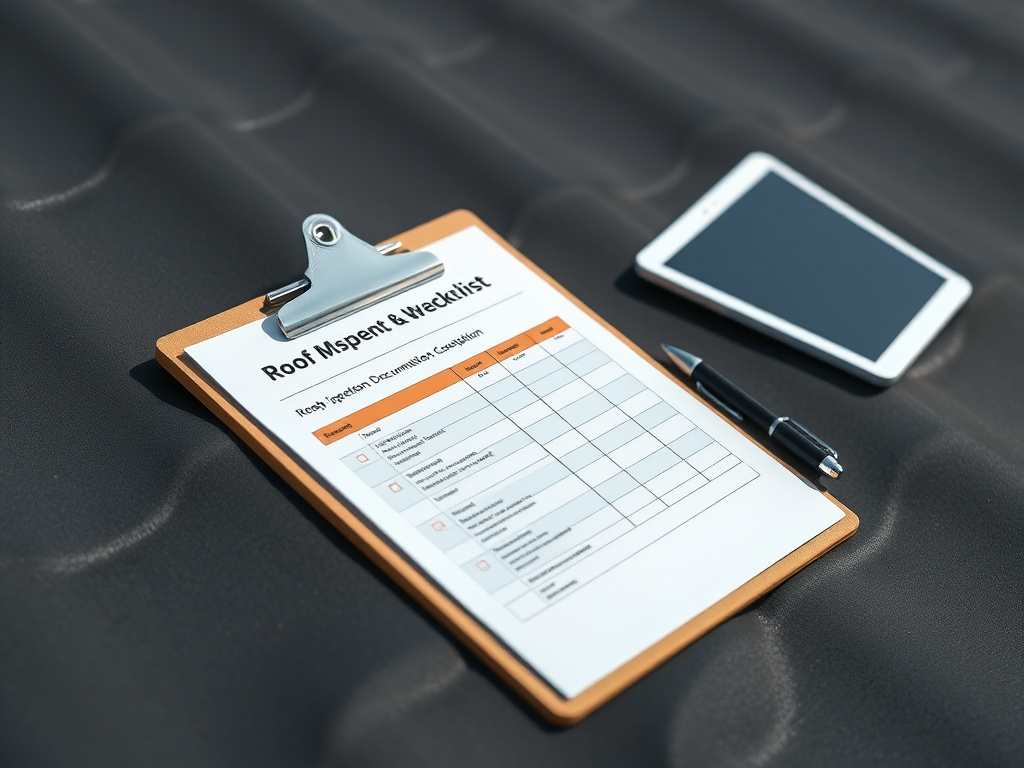
Warranty-file evidence, on a schedule
Roof Asset & Warranty Documentation Programs
Most EPDM manufacturer warranties don't just require the right materials at install — they require proof, on an ongoing basis, that the roof has been inspected and maintained the way the warranty specifies. A repair history without paperwork behind it isn't automatically a compliance failure, but a manufacturer reviewing a warranty question has no way to tell the difference between 'this was done right and undocumented' and 'this was never done.'
The paperwork problem
Why a Documentation Gap Functions Like a Compliance Failure
Commercial low-slope roof warranties generally fall into three tiers: material-only, workmanship, and NDL — "No Dollar Limit" — or system warranties. NDL and system warranties are the ones building owners actually care about, and they're also the ones with the most conditions attached, because the manufacturer is carrying long-term financial exposure on the roof staying in good condition. That exposure is exactly why many of these warranties require periodic inspections, and a maintenance or repair record, to stay in force for the full term.
Here's the part most building owners don't find out until it matters: a missed required inspection or an undocumented repair is often treated by a manufacturer's warranty department the same way a missed physical maintenance requirement would be. It doesn't matter whether the roof was actually inspected and maintained correctly by someone at some point — if there's no dated report, no material or lot documentation, and no record of who performed the work, the warranty file has a hole in it. At a warranty-claim or ownership-transfer review, that hole gets resolved against the building owner by default.
This is a different problem than a bad repair. A genuinely non-compliant repair — the wrong adhesive, an uncertified crew — is a material failure of the warranty's terms. A documentation gap is a paperwork failure of the same terms, and it's far more common, because it happens silently: a property changes management companies, an inspection gets skipped during a busy season, a repair invoice gets filed somewhere nobody can find years later. None of that shows up as a leak. All of it shows up the moment a warranty question actually gets asked.
Our documentation programs exist specifically to close that gap before it's tested — building a warranty file that holds up on its own, independent of whether anyone remembers the details of a given site visit five years from now.
What's actually in the program
What a Warranty-Support Inspection Program Includes
Every deliverable in the program is built to stand on its own as warranty-file evidence — not just as a general maintenance record.
| Inspection cadence | Scheduled to match the interval your manufacturer's warranty terms specify, typically semi-annual to annual |
|---|---|
| Report format | Dated, site-specific report with photos of seams, flashings, drains, and any active or developing issues |
| Material & lot tracking | Documented material batch/lot references for any repair performed, tied to the manufacturer's approved-materials list |
| Installer records | Certified/authorized-installer identification for every repair, kept with the report it corresponds to |
- ✓Dated inspection reports on a schedule matched to your roof's specific warranty requirements, not a generic annual default
- ✓Photo documentation of seams, flashings, drains, and penetrations at every visit, filed against the same site record over time
- ✓Material and lot documentation for any repair performed, cross-referenced to the manufacturer's approved-materials list
- ✓Certified-installer records identifying who performed each repair, satisfying programs that gate warranty eligibility behind authorized-contractor work
- ✓A single running file per property (or per portfolio), not a scattered set of invoices and one-off PDFs across different vendors
- ✓A plain-language summary after each visit flagging anything that needs attention before it becomes an active leak or a warranty question
Starting from zero paperwork
Rebuilding a Warranty File After a Property Transfer or Lost Paperwork
A large share of the properties we start documentation programs on don't have a clean file to begin with. Ownership changed hands, a property management company turned over, or the original installer's paperwork was simply never passed along past the initial install. In every one of those cases, the building still has whatever warranty was originally issued — the roof doesn't lose its warranty because the paperwork got lost — but nobody can currently prove what that warranty covers or requires.
Rebuilding that file starts with identifying the original manufacturer and, where possible, the program tier — material-only, workmanship, or NDL/system — from whatever evidence still exists: membrane markings, old invoices, permit records, or a call to the manufacturer directly. From there, we establish a current-condition baseline inspection, which becomes the new starting point for the warranty file even if the years before it stay undocumented.
This baseline-and-forward approach matters most for multifamily and condo associations that inherited a developer-issued warranty, and for institutional properties working from a capital-improvement or bond-funded audit requirement where a documented paper trail is part of the deliverable, not just a nice-to-have. See who we serve for how the documentation approach adapts across property types and portfolio structures.
For a portfolio with roofs under a single national-account manufacturer program, we also confirm that the certified-installer requirement is being met consistently across every site — see manufacturer-certified repair programs for how those requirements typically work and why one non-compliant site can be a portfolio-wide question, not just a local one.
Why this matters later
How These Records Support a Future Warranty Claim
The value of a documentation program is easiest to see the day it's actually needed — when a manufacturer is reviewing whether a specific piece of damage is covered under an active warranty, or when a property is being sold and a buyer's due-diligence team wants proof the roof was maintained to spec. At that point, a complete file of dated inspections, material records, and certified-installer documentation is the difference between a straightforward conversation and a contested one.
A future warranty claim is far easier to support when the record already exists in the format a manufacturer expects, rather than being assembled after the fact from whatever can still be found. Inspection reports that show the roof was checked on schedule, repair records that show approved materials were used by a qualified installer, and photo documentation that shows conditions over time all work together as evidence — not just as a maintenance log.
This is also where documentation and active repair work connect directly. If an emergency repair happens between scheduled inspections, that visit — including any temporary stabilization and the permanent repair that followed it — gets folded into the same running file rather than existing as a separate, disconnected event. See emergency leak response for how warranty-safe emergency work is documented as part of this same process.
If you're not sure what your roof's current documentation status is — or whether one even exists — that's worth finding out before it's tested by an actual warranty question. Start a free assessment and we'll evaluate your roof's current warranty file alongside its physical condition.
Common questions
Documentation Programs, Answered
Straightforward answers on rebuilding, maintaining, and using a warranty-support documentation file.
Start a free assessmentCan you help rebuild warranty documentation for a roof I don't have paperwork for?
+
Yes — this is one of the most common starting points for a documentation program. We work from whatever evidence still exists (membrane markings, old invoices, permit records, or a direct call to the manufacturer) to identify the original manufacturer and program tier, then establish a current-condition baseline inspection that becomes the new starting point for the file going forward.
Will you provide documentation I can add to my building's roof or warranty file after a repair?
+
Every repair we perform generates a dated report with photos, the material and lot information used, and the certified-installer record for that visit. It's built specifically to be dropped into an existing warranty file or to start a new one, in the format a manufacturer's warranty department expects to see.
How often does an EPDM roof actually need to be inspected to stay compliant?
+
It depends on the specific manufacturer program and warranty tier, but semi-annual to annual is typical for NDL and system warranties that carry a periodic-inspection requirement. Where the exact interval isn't documented for your roof, we default to the more frequent schedule until it can be confirmed against the original warranty terms.
What happens if we find a documentation gap partway through the program?
+
We flag it plainly in the next report rather than papering over it. A known, disclosed gap with a clear baseline going forward is a defensible position; an undisclosed one discovered later by a manufacturer's warranty department is not. Most gaps are addressable — the goal is making sure nothing is hidden or ambiguous in the file.
Get your warranty file in order
Tell us what you already have — even partial or old paperwork — and we'll tell you what's missing, what's still valid, and what a warranty-support inspection program would look like for your property.