Method-first restoration
Liquid-Applied EPDM Restoration Systems
Most companies pitch a liquid coating as a way to extend roof life for less than a tear-off. That's true, but it skips the question that actually matters on a warrantied roof: is this specific coating recognized by your membrane's manufacturer as compatible — or does it quietly put your existing warranty at risk? We answer that question before we quote the job, not after.
What this actually is
What liquid-applied restoration is
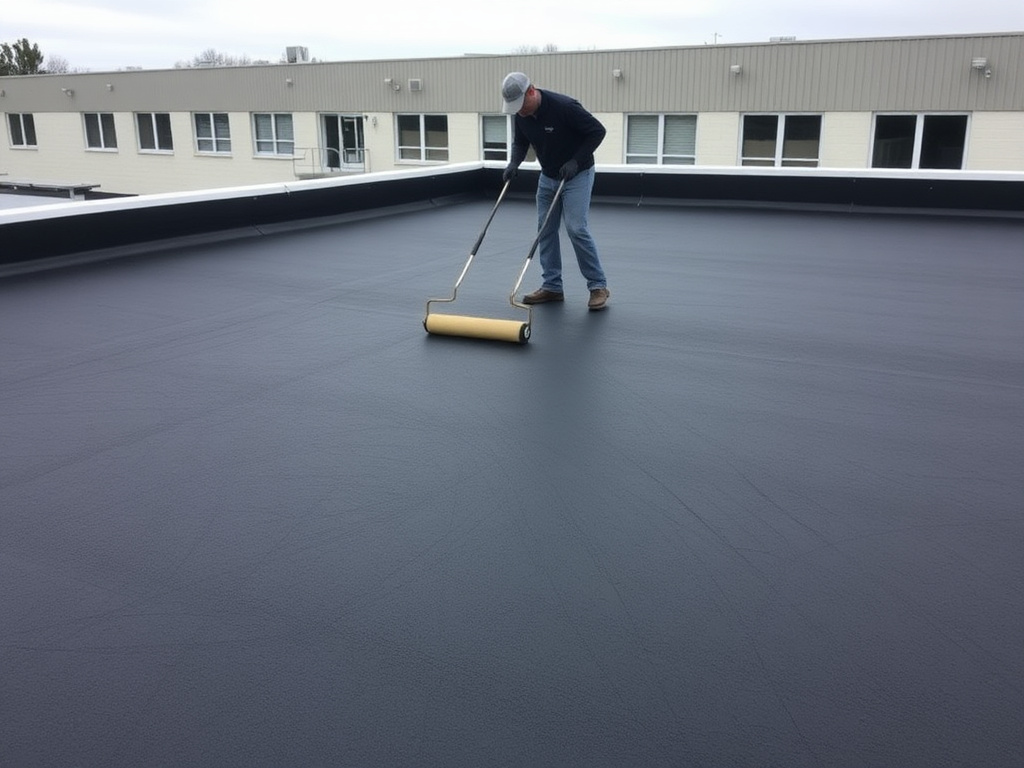
Liquid-applied restoration is a fluid-applied membrane system — typically an acrylic, silicone, or EPDM-specific liquid rubber formulation — rolled, sprayed, or squeegeed over an existing EPDM roof to form a new, seamless, fully adhered surface on top of the original membrane. Done correctly, it renews the roof's weathering surface, restores UV and ponding resistance at the top layer, and can add years of service life without a tear-off.
Unlike a patch or a splice, which addresses a specific defect at a specific location, a restoration system is applied across the full roof field. That scale is exactly why the compatibility question matters more here than almost anywhere else on the building — a coating chosen without checking manufacturer compatibility doesn't put one seam at risk, it's applied over the entire warrantied membrane at once.
These systems are genuinely useful, and we install them regularly. The issue isn't the category — it's that "liquid-applied restoration" gets marketed as a single generic service when it's actually a family of different chemistries, each with its own primer requirements, cure behavior, and — critically — its own relationship (or lack of one) to the membrane manufacturer's approved-materials list.
For the seam-level version of this same compatibility question, see our page on seam splicing & tape systems. Both pages answer the same underlying question — does this repair material match what the original manufacturer will actually recognize — just at different scales.
Restoration is also usually a maintenance-cycle decision rather than an emergency one. Most buildings that end up looking at a liquid system aren't dealing with an active leak — they're dealing with a membrane that's showing UV wear, surface chalking, or early ponding-related degradation, and a facilities team weighing recoat-now against replace-later. That timeline gives you room to actually verify compatibility properly before committing, instead of making the call under leak-driven pressure the way an emergency repair sometimes has to.
The question most coating companies skip
The warranty-compatibility question most coating companies never ask
A generic recoating pitch usually starts and ends with square footage and price per square. What it typically doesn't include is a check against your specific roof's manufacturer and warranty tier — because most coating-only companies aren't set up to do that check, and a coating job that "looks fine" for the first year or two rarely surfaces a compatibility problem immediately.
The risk isn't that the coating will fail to stick. Most liquid restoration products bond to EPDM reasonably well when applied correctly. The risk is administrative: many EPDM manufacturers only recognize specific liquid-applied systems — often their own branded line, or a small list of formally partnered products — as compatible with a base membrane warranty. Applying a coating outside that list doesn't necessarily damage the roof, but it can create a documented, unapproved modification that a manufacturer is entitled to point to later.
This is a genuinely different question from "will this coating work." A coating can perform beautifully for a decade and still have been the wrong choice from a warranty-file standpoint, if nobody checked whether it was on the manufacturer's approved list before it went down. Once it's rolled out across an entire roof field, there's no small-scale way to walk that decision back.
We ask the compatibility question before every restoration quote, not after. That usually means confirming the base membrane's manufacturer and warranty status first — the same first step described on our manufacturer-certified repair programs page — and then narrowing the coating options to the ones that manufacturer actually recognizes for that roof.
What compliance requires
Prep and primer requirements that affect compliance
Surface preparation isn't just a workmanship detail on a restoration job — several of these steps are conditions a manufacturer sets for a coating to be recognized as compatible at all. Skipping or shortcutting them can affect compliance even when the right coating product was chosen.
This is one of the most common gaps between a compliant restoration and a coating job that merely looks fine at handoff. Two crews can apply the identical coating product to the identical roof and produce a very different compliance outcome, based entirely on whether the membrane was cleaned and primed to the manufacturer's actual spec — not just rinsed off and rolled over.
- ✓Membrane cleaning to remove surface chalk, dirt, and biological growth using a method appropriate to EPDM — not a generic pressure-wash approach that can drive water under existing seams.
- ✓Seam and detail inspection before coating, so an existing seam or flashing defect isn't sealed over and hidden rather than repaired.
- ✓Manufacturer-specified primer application, matched to both the membrane and the coating chemistry being applied over it — not a universal primer chosen for convenience.
- ✓Cure-time and weather-window adherence during application, since coating over a membrane that hasn't been prepped or primed within the manufacturer's specified window can void the compatibility basis entirely.
- ✓Mil-thickness and coverage-rate verification, documented at application, since under-thickness coating can fail to perform as the manufacturer's tested system assumes.
- ✓Post-application documentation — product lot numbers, primer used, and coverage records — filed as part of the roof's ongoing warranty record.
On a multi-building portfolio, we run this same checklist per roof, not once per contract. A restoration crew moving between sites on a schedule can be tempted to standardize prep across every building for speed — but two roofs a few miles apart can carry different manufacturers, different membrane ages, and different warranty status, which means the compliant prep sequence isn't always identical from site to site even within the same job.
What's realistic
Stacking a supplemental coating warranty on an existing membrane warranty
Building owners often assume a coating automatically comes with its own new, separate warranty layered on top of whatever the base membrane already carries. Sometimes that's realistic. Often it isn't, at least not in the way it's implied by a sales pitch — and the honest answer depends on which coating system is used and whether the base membrane warranty is still active.
Where a manufacturer-recognized system is applied to a roof with an intact, still-active base warranty, it's sometimes possible to add a supplemental coating warranty without disturbing the underlying membrane warranty term. That's the best-case outcome, and it's realistic — but only when the coating is on that manufacturer's approved list and the prep/primer requirements above were followed and documented.
Where the base membrane warranty has already expired, or where a generic non-recognized coating is used regardless of warranty status, the "new warranty" being sold is typically a separate, standalone workmanship or material warranty from the coating manufacturer or applicator — not a warranty that extends or restores the original roof system's coverage. That's still a legitimate and useful warranty. It's just a different thing than what a "renews your roof warranty" pitch tends to imply.
We tell you which situation applies to your roof before the work is scheduled, not after, including what documentation you'll have in hand once the restoration is complete. Our roof warranty documentation programs page covers how that paperwork gets built and maintained over time.
It's worth asking any contractor quoting a restoration coating to put the answer to this question in writing before you sign anything: does the base membrane warranty remain active and unaffected under this specific coating system, and is that coating actually on the manufacturer's recognized list for this roof, or is it a standalone product being sold as if it were an extension of coverage you already have. A straight answer to that one question tells you most of what you need to know about whether a quote is warranty-safe.
When we say no
When we recommend against a liquid system
A restoration coating isn't the right answer for every roof, and recommending one anyway is how a coating company protects a sale rather than a client's warranty position. A few patterns come up often enough to call out directly. A membrane with widespread seam failure or extensive punctures generally needs those defects addressed as their own repairs first — coating over unresolved seam or puncture issues doesn't fix them, it hides them under a new surface until the coating itself eventually shows the same failure telegraphed from underneath.
Persistent, long-duration ponding water is another common disqualifier. Standing water beyond a manufacturer's specified duration is frequently treated as its own warranty exclusion, independent of the membrane's condition — coating over a roof with an unresolved ponding problem doesn't remove that exclusion, and in some cases a coating applied over standing water can trap moisture rather than shed it.
A roof already near the end of its membrane's realistic service life, with widespread substrate or insulation issues underneath, is usually a case where a restoration coating buys limited time at real cost, when a broader repair or replacement conversation would serve the building better. And on any roof where we can't confirm the manufacturer or the current warranty status at all, we won't default to "coat it anyway" — an unverifiable roof gets a documentation and inspection pass before a restoration recommendation, not after one.
In each of these situations we'll say so plainly, along with what we'd recommend instead — a targeted repair, a drainage correction, or a documentation-first inspection — rather than quoting a coating job we don't think is the right fit for your roof's actual condition.
Turning down a restoration quote costs us a sale in the moment. It's still the right call more often than the coating industry's marketing suggests, and it's the reason a method-first assessment — checking the membrane, the seams, the drainage, and the manufacturer records before recommending anything — has to come before a restoration conversation, not alongside it.
Confirm compatibility before you coat
Send us your roof's manufacturer, or a few photos if you're not sure. We'll confirm which liquid-applied systems are actually recognized for your roof before any restoration work is quoted.
Related reading
Go deeper on seam, material, and documentation compliance
Seam Splicing & Tape Systems
The same compatibility question, applied at the seam level — cured cover tape, in-seam splicing, and matched primer/adhesive chemistry.
Warranty-Compliant Patch Materials
Why "it's all EPDM" is a myth for warranty purposes, and how patch material compatibility is confirmed before a repair.
Roof Warranty Documentation Programs
How inspection records, material lots, and coating documentation get built into a defensible warranty file over time.